





Plumbing gets lumped in with HVAC and roofing as a "seasonal home service," but the demand pattern is different. Plumbing problems spike around specific triggers, freezing temperatures, holiday cooking and hosting, aging water heaters, and irrigation season, not a single clean hot and cold split.
A profile optimized only for generic "plumber near me" misses the sharper, higher intent searches that spike around these specific triggers, searches that convert at a much higher rate because the person searching has an active, urgent problem.
Demand Triggered Strategy, Not a Static Keyword List

Cold Weather, Frozen and Burst Pipes
As temperatures drop toward freezing, we shift emphasis toward frozen pipe repair, burst pipe emergency service, and pipe insulation. These are searches that spike hard and fast during and right after a cold snap, with high urgency and conversion intent.
Post Holiday, Clogged Drains and Garbage Disposals
The days immediately following Thanksgiving and Christmas reliably produce a spike in clogged drain and garbage disposal repair searches from cooking grease and food waste. We increase content and post activity around these specific services in the days leading up to and following major holidays.
Water Heater Season
Water heater failures cluster in colder months when the unit works hardest and older units finally fail. We track this as a distinct seasonal push separate from general "plumber" searches, since "water heater repair" and "water heater installation" searches carry strong commercial intent.
Warm Weather, Irrigation and Outdoor Plumbing
As irrigation systems come back online and water usage climbs, sprinkler line repair, outdoor spigot repair, and sewer line issues become more searched. We shift emphasis accordingly rather than running the same profile focus year round.
What Is SEO for Plumbers
SEO for plumbers is the practice of optimizing your website, your Google Business Profile, and your overall online presence so plumbing customers actually find you when they search, whether that's a homeowner typing "plumber near me" at 11pm with a burst pipe, or someone quietly researching water heater replacement costs a week before they're ready to buy.
Done properly, it works on three fronts at once. The technical side of your website, so Google can actually crawl and understand it. The content on your site and profile, so it matches what real customers are actually searching for. And your reputation signals, meaning reviews and citations, which tell Google your business is a real, trustworthy operation worth showing to searchers. None of this replaces word of mouth or repeat business, but it's the modern equivalent of being listed first in the phone book, except the phone book now decides who gets seen first based on dozens of signals most business owners never think about.
Why Plumbing Companies Need SEO
Plumbing is one of the more resilient categories in home services, since pipes don't stop breaking during a slow economy, but how customers find a plumber has changed completely. Cold calling and print ads reach fewer people every year, while search has become the default starting point. Recent consumer research on local search behavior puts the share of consumers who use Google specifically to find local business information at over 70 percent, and that number has kept climbing rather than leveling off.
For plumbers specifically, the searches that matter most are short and local. "Plumber near me." "Emergency plumber" plus a city name. "Water heater repair" plus a city name. These aren't people browsing. They're people with an active problem and a phone already in hand, which is exactly why ranking well for them tends to produce some of the highest converting leads a plumbing business can get, often at a lower ongoing cost than paid ads once the ranking is established.
Google Business Profile Optimization for Plumbing Companies
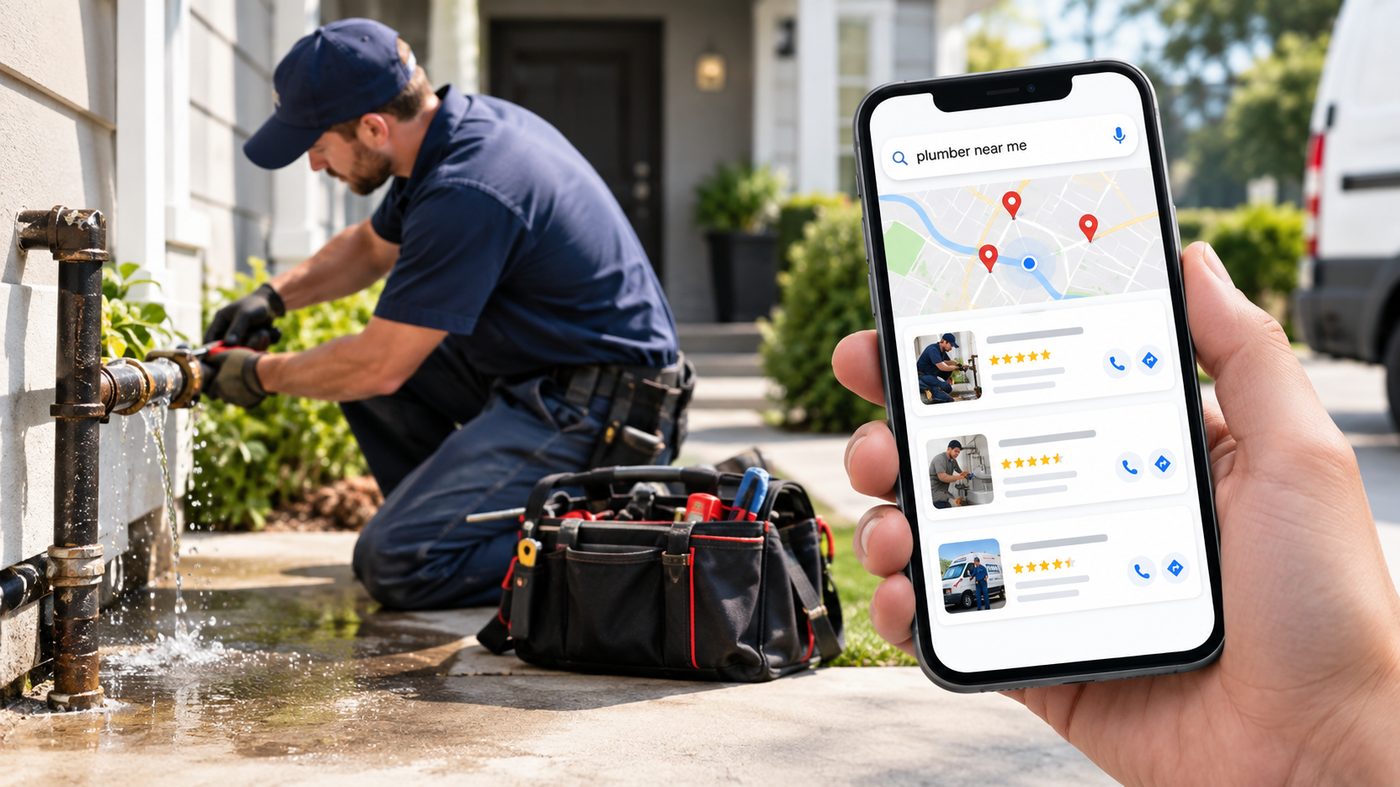
Demand trigger category work is the highest value lever for plumbing, but it depends on a profile that's accurate and complete underneath it. Since most plumbing companies operate as service area businesses rather than storefronts, getting the service area radius genuinely right, matching where you actually dispatch technicians rather than an inflated radius chasing more impressions, is one of the most consequential and most commonly mishandled settings on the entire profile.
Photos matter for the same trust reasons they do in any home service trade. Branded vehicles, technician photos, and before and after shots of completed work, a repiped section, a newly installed water heater, a cleared out drain line, do more to convert a click into a call than a logo image ever will. The Products and Services section deserves the same specificity. Listing "Drain Cleaning," "Water Heater Installation," "Leak Detection," "Sewer Line Repair," and your other core services individually, each with its own short description, gives Google far more to match against a searcher's exact need than one generic "Plumbing Services" entry.
Local Citations and Directory Listings for Plumbing Businesses
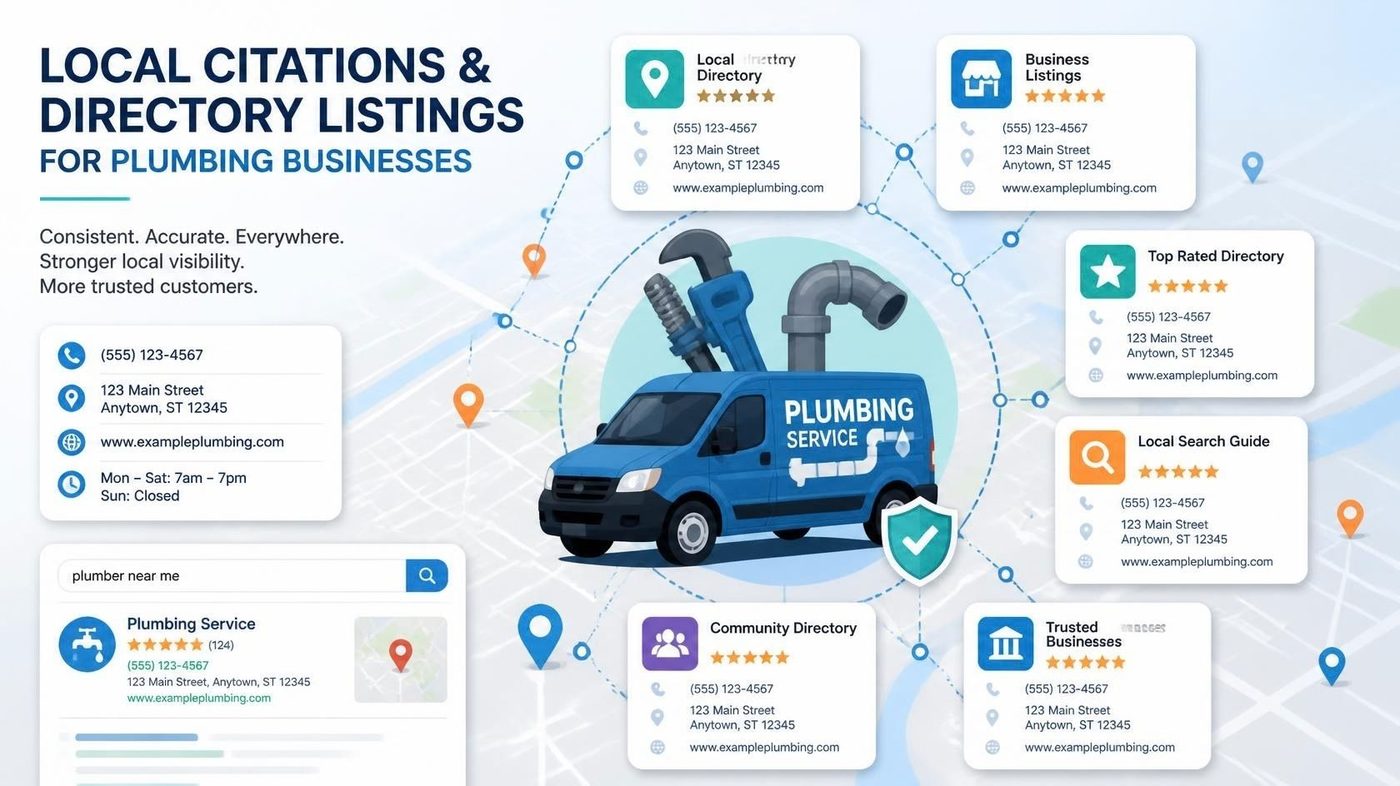
The standard citation sources apply here too. Yelp, Angi, the Better Business Bureau, Nextdoor, Thumbtack, all kept exactly consistent with what's on your Google Business Profile. But plumbing has citation opportunities beyond the obvious list that most companies never claim.
If you're a certified installer for a water heater or fixture manufacturer, Rheem, A.O. Smith, Bradford White, Moen, Kohler, Rinnai, their "find a pro" or certified installer directories are high authority citations from domains Google already trusts, and they're frequently left unclaimed or out of date. Local chapter listings for trade associations like PHCC (the Plumbing-Heating-Cooling Contractors Association) work the same way. We audit for these specifically, since they're some of the highest value citations available and the ones competitors are least likely to have claimed.
Website Content and On-Page SEO for Plumbing Companies
A Google Business Profile can only carry so much. A website with genuinely useful content extends your visibility to research stage searches your profile alone can't capture, direct answer guides ("why is my water heater leaking," "how much does sewer line repair cost"), real pricing ranges rather than a vague "contact us for a quote," and content timed to the same demand triggers described above, so a frozen pipe prevention guide is live and ranking before the first hard freeze of the season, not after.
Underneath the content itself, a set of technical factors determines whether any of it actually ranks. A secure, HTTPS enabled site, genuine mobile responsiveness, fast page load times, clean schema markup identifying your business and services to search engines, and images that are compressed and properly labeled rather than slowing the page down. None of this is exotic. It's foundational work that a surprising number of plumbing company websites still get wrong, and it's part of what's covered in our Local SEO and Google Business Profile Ranking Service.
What Determines Your Local Pack Ranking
The local pack is the block of three businesses Google shows at the top of the results for a local search, sitting right next to the map. Getting into it is worth more than almost anything else in local SEO, since those three spots capture the large majority of clicks for a local search, well ahead of anything ranking below them.
Google weighs three factors when deciding who appears there. Distance, meaning how close your listed address or service area is to the person searching. Relevance, meaning how well your profile and website match what was actually searched, which is where accurate categories and real service descriptions matter most. And prominence, meaning how well known and trusted your business appears to be, based on review volume, review quality, citations, and how complete your overall online presence is.
Distance is the one factor you can't fully control, since Google decides that based on where the searcher physically is standing or searching from. Relevance and prominence are where the actual work happens, and where a business that puts in consistent effort reliably outranks one that doesn't, regardless of how long either has been in business.
Why Backlinks Still Matter, But Only the Right Kind
Links from other websites pointing to yours are one of the signals Google uses to judge how authoritative and trustworthy your site is, and for plumbing companies, the strongest sources are usually the most overlooked. Manufacturer certified installer pages, local chamber of commerce listings, and the Better Business Bureau. These tend to carry more weight than a generic directory listing because the domain itself is already trusted.
What doesn't work, and what can actively hurt you, is buying links specifically to manipulate rankings. Google's guidelines treat this as a violation, and a site caught doing it can lose rankings across the board, not just for the pages involved. The sustainable path is slower but far safer. Earn links by being a legitimate, well documented business and by publishing content genuinely worth referencing, rather than shortcutting the process.
Reviews and Reputation Management for Plumbing Companies
Review volume and rating feed directly into the prominence signal Google's local pack ranking weighs, and plumbing has a natural advantage. A lot of plumbing calls are emergencies, and the relief of having a burst pipe or backed up sewer line fixed tends to produce some of the most genuine, detailed reviews a home service business can get, if you ask at the right moment.
We build review requests into the workflow right after the invoice is paid, when the problem is freshly solved and satisfaction is at its peak, rather than a generic delayed reminder that misses the moment. We also manage responses to every review, since a thoughtful reply to a negative review is often what a prospective customer reads most closely before deciding who to call for something as high trust as letting a plumber into their home.
Getting Recommended in AI Overviews and AI Search
Plumbing questions are perfect for AI search. Someone with a leaking water heater or a toilet that won't stop running asks Google, ChatGPT, or Gemini what to do right now. The AI Overview usually gives them the first steps, shut off the water, check the valve, and then points them to a local plumber who can come out today.
If your website already answers those questions clearly, with real advice and a clear next step to call you, AI tools have something worth citing. Pair that with a complete Google Business Profile, steady reviews that mention the specific jobs you did, and consistent details on Bing Places, Apple Business Connect, Yelp, and Angi, and you give AI every reason to name you.
We write that content around your demand triggers, frozen pipes, holiday drain calls, water heater season, and we test what Google AI Mode and ChatGPT say when someone in your service area asks for help. No one can guarantee a mention in an AI answer, but we can make sure the information it finds about you is accurate, consistent, and better than the next plumber's.
We're Not Trying to Be Just Another Marketing Vendor
A lot of plumbing business owners have already been through this. An agency that sent monthly reports full of impressions and keyword rankings while the phone stayed quiet. A marketing company that clearly understood Google but had never actually run a home service business a day in its life. A lead platform selling the same homeowner's information to you and two or three competitors at the same time, so everyone ends up bidding against each other for a lead none of you fully own.
We built MyLocalGuard around a simpler standard. Rankings and traffic are only worth reporting on if they turn into calls and booked jobs, and that's what we actually track and talk to you about. We're not a lead generation platform reselling your leads elsewhere. We work directly on your own Google Business Profile and your own website, so what gets built stays yours. And we'd rather give you a clear plan and an honest timeline up front than promise something dramatic in month one and hope you don't ask too many questions by month four.