





HVAC is one of the most seasonally volatile categories in local search, and most local SEO providers treat it like any other home service business. They optimize once, send a monthly report, and never touch the actual strategy again. That approach leaves real ranking opportunity sitting on the table every single season.
Search demand for HVAC services doesn't move gradually across the year. It swings hard and fast with the weather. A heat wave can spike "AC repair near me" searches within 48 hours. A cold snap does the same thing for "furnace repair" and "no heat emergency." A profile optimized only for generic "HVAC services" misses the surge in both directions, right when the demand is at its highest.
Our Seasonal Category Switching Strategy
We actively manage your Google Business Profile's primary and secondary categories, services list, and content focus based on what's actually in demand right now in your market, not a strategy we set once in January and forget about.

Cooling Season
As temperatures rise, we shift your primary category and profile emphasis toward AC repair, AC installation, AC maintenance, and general cooling services. This is when "AC not cooling," "AC repair near me," and "AC installation cost" searches peak, and we want your profile positioned to win those searches specifically, not competing generically against every HVAC company in your area.
Heating Season
As temperatures drop, we shift the same profile toward heating repair, furnace repair, and heat pump repair. A company still defaulted to AC repair as its primary category in December is basically invisible for the searches actually happening in their market that month. It's a surprisingly common mistake, and an easy one to avoid.
Shoulder Seasons
Spring and fall carry different demand entirely. Tune ups, inspections, and system replacement research all pick up. This is when homeowners are planning ahead rather than searching in a panic, so we shift content and posts toward maintenance plans and replacement guidance rather than emergency repair language.
Weather Triggered Demand Spikes
Beyond the broad seasonal shift, we keep an eye on real time conditions in your service area. A sudden heat wave or cold snap creates a short window of extremely high intent searches, and a profile that's ready for it, with accurate hours, active posts, and fast review response, captures a much bigger share of that spike than one that isn't.
Google Business Profile Optimization for HVAC Companies
Seasonal category switching is the highest value lever we use, but it only works on top of a profile that's accurate and complete in the first place, in line with Google's own guidelines for representing a business. We treat this as the foundation every HVAC profile needs before the seasonal strategy can do its job.
That starts with getting the basics exactly right. Your service area radius should match where you actually send technicians, your hours should be accurate including any extended hours during a heat wave or cold snap, and your phone number should match what's on your website and every directory listing. These mismatches are surprisingly common, and they quietly cap how much Google trusts the profile even when everything else looks fine. If your profile was never verified in the first place, or a previous verification attempt was revoked, that's a separate issue worth sorting out first through our Verification Service, since none of this optimization work matters until the profile is actually live.
Photos and videos matter more for HVAC than most trades, because homeowners are letting a stranger into their home and want to see who's actually showing up. We prioritize technician headshots, branded trucks, before and after equipment photos, and short video walkthroughs of a completed install or a technician explaining a common repair. A logo and stock photography do very little for either ranking or conversion here.
The Products and Services section is where a lot of HVAC profiles waste real opportunity. Listing "AC Repair," "Furnace Installation," and "Heat Pump Maintenance" individually, each with a short description, gives Google far more to match against a searcher's exact query than one generic "HVAC Services" line ever could.
Local Citations and Directory Listings for HVAC Businesses
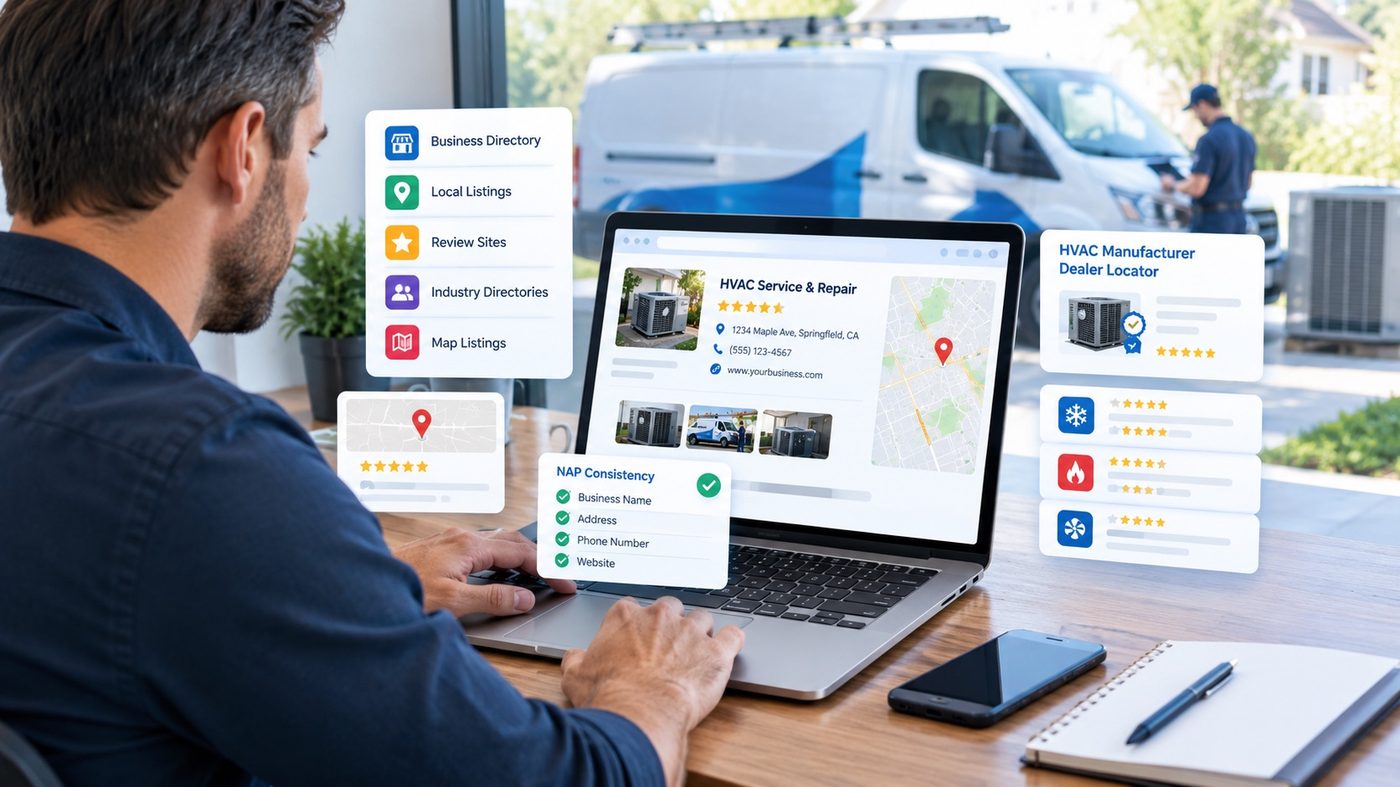
Citations are your business name, address, and phone number listed consistently across other websites, commonly shortened to NAP, and they're a meaningful trust signal for Google. This is also an area where HVAC companies have an advantage most other trades simply don't have access to.
The standard citation sources apply here too. Yelp, the Better Business Bureau, Angi, Nextdoor, and Apple Maps, all kept exactly consistent with what's on your Google Business Profile. But HVAC has a citation source that's often overlooked entirely, which is manufacturer dealer locator pages. If you're an authorized dealer for Carrier, Trane, Lennox, Goodman, Rheem, or another major manufacturer, your listing on their official dealer locator is a high authority citation from a domain Google already trusts heavily. Most HVAC companies never claim it or update it after their initial certification. We check for these specifically as part of the citation work, alongside the standard directory list.
NAP consistency matters just as much as coverage. A business that's "AC Repair Pros LLC" on the website, "AC Repair Pros" on Yelp, and "A/C Repair Pros" on a manufacturer locator page creates exactly the kind of inconsistency that dilutes the trust signal citations are supposed to build. In more serious cases, it even contributes to the same profile compliance issues we deal with directly in our reinstatement service once they trigger a suspension.
Content Marketing and Blog Strategy for HVAC Companies
A Google Business Profile can only carry so much content on its own. A website with genuinely useful HVAC content, written for homeowners rather than search engines, extends your visibility to research stage searches your profile alone can't fully capture. It also gives Google, along with AI generated search summaries, a real reason to treat your site as a trustworthy source on the topic.
The strongest performing content for HVAC companies tends to fall into a few categories. Direct answer guides to common problems, like "why is my AC blowing warm air" or "how often should a furnace filter be replaced," cost and pricing transparency content that gives a genuine range for a service call, an install, or a specific repair (a vague or missing pricing page is one of the most common gaps we find), and seasonal readiness content timed to the same cooling and heating shifts described above, so a blog post promoting AC tune ups actually publishes right as cooling season search volume starts climbing instead of months later.
We also structure this content in a clear question and answer format wherever it fits naturally. Beyond helping human readers scan for the answer they actually need, well structured Q&A content is exactly the format Google's AI Overviews and other AI generated search summaries pull from most often. A business that answers "how much does it cost to replace a furnace" clearly and specifically has a real shot at being the source cited in that summary, while a page that buries the answer in marketing copy usually doesn't.
How Long Does HVAC SEO Take to Show Results
Local SEO is a compounding investment, not a light switch you flip once. We'd rather set honest expectations up front than promise something fast and disappoint you three months in, so here's a realistic timeline for HVAC specifically when the work is actually done right.
In the first one to three months, most of the work is foundational. Fixing categories and profile accuracy, cleaning up citations, and doing the keyword research that everything else builds on. You'll often see early wins on lower competition, longer tail local searches during this window, even before the bigger keywords move.
Between months three and six, content starts pulling real weight. Service pages and location pages begin ranking, organic traffic trends upward, and calls or form submissions from search start showing up with some regularity rather than as one off events.
From six months to a year, the compounding really kicks in. Rankings tend to stabilize on more competitive terms like "AC repair" plus your city name, lead flow becomes something you can actually plan around, and your effective cost per lead usually drops well below what paid ads cost for the same volume.
Past the one year mark, the HVAC companies that end up dominating their market are almost always the ones who kept investing after the early results showed up rather than pulling back. Consistent SEO becomes a lead the competition can't easily close once you've built it, especially layered with the seasonal strategy described above. Every market moves at a slightly different pace, and on a strategy call we'll tell you what to realistically expect in yours instead of handing you a number that sounds good but doesn't mean anything.
What Good HVAC SEO Actually Looks Like
A lot of HVAC contractors have paid a monthly retainer for SEO that never really moved anything. It's a common, frustrating experience, and it's usually the result of a few specific shortcuts rather than SEO itself not working. Here's what tends to separate the two.
Weak HVAC SEO usually looks like duplicate city pages with nothing but the city name swapped out, vague monthly reports that never connect back to actual leads, backlinks built through spammy, low quality sites that risk a Google penalty rather than helping, a Google Business Profile treated as an afterthought instead of the core asset it actually is, and a templated strategy that's never really adjusted based on how your specific site is performing.
Strong HVAC SEO looks different in almost every one of those areas. Honest timelines and monthly reporting that's actually tied to real calls and leads, content that answers the exact questions homeowners are already asking, a local first strategy built around your Google Business Profile, city and neighborhood pages, reviews, and citation consistency, a fast, mobile friendly website built to convert traffic into booked jobs rather than just visits, and a strategy that keeps getting adjusted based on what the data actually shows month to month. It also means being honest that SEO works alongside paid channels like Google's Local Services Ads rather than pretending organic rankings are the only lever worth pulling.
If your current provider can't clearly explain what they did last month and what it actually produced in calls or booked jobs, that's usually your answer already. We're happy to take a look and give you a straight, honest read on where things stand.
Technical SEO and Website Optimization
A Google Business Profile that ranks well only gets you halfway there. Once a homeowner clicks through from the local pack, your website has to load fast, display cleanly on their phone, and make it obvious how to book. Otherwise that click turns into a call to your competitor instead.
Site Structure and Internal Linking
Search engines and visitors both need to find their way around your site easily. That means clear navigation, descriptive URLs, and internal links that connect your service pages, service area pages, and blog content to each other in a way that actually makes sense. A site where every page links back to the homepage and nowhere else is much harder for Google to understand, and harder for a homeowner to browse too.
Mobile Speed and Usability
Most HVAC searches, especially the urgent "no cool" or "no heat" ones, happen on a phone, often from someone standing in a hot or cold house who wants an answer right now. A slow loading page or a phone number buried three scrolls down costs you the call. We check page speed with tools like Google PageSpeed Insights, and prioritize the fixes that matter most for mobile visitors specifically. Fast load times, a click to call button that's actually visible without scrolling, and forms that are easy to fill out on a small screen.
Where This Fits Into Your Ranking Strategy
Technical SEO and website optimization aren't separate from the seasonal Google Business Profile strategy above. They support it directly. A profile optimized for "AC repair near me" during a heat wave still needs a website behind it that turns that click into a booked call instead of a bounce. This is part of what's included in our Local SEO and Google Business Profile Ranking Service, alongside everything described above.
Getting Recommended in AI Overviews and AI Search
A homeowner whose heat pump is blowing cold air in January doesn't always search "HVAC company near me" anymore. They type the whole problem into Google and read the AI Overview, or they ask ChatGPT or Gemini what's wrong and who can fix it today. Those answers often explain the likely cause first and then name a few local companies to call.
The companies that get named are the ones AI can describe with confidence. That comes from a complete Google Business Profile, reviews that mention specific jobs like furnace repair, AC replacement, or emergency calls, and a website that answers real seasonal questions in plain language. A page that explains why a furnace short cycles, or what a fair price for a new AC unit looks like in your area, is exactly the kind of content AI tools quote.
We build that into the seasonal plan. As demand shifts between cooling and heating, we add FAQ content for the questions people are asking that season, keep your details consistent on Google, Bing Places, and Apple Business Connect, and check what AI Overviews, AI Mode, and ChatGPT say when someone in your area asks for help. Nobody can promise a spot in an AI answer, but we make sure everything AI finds about you points to the same conclusion: you're the one to call.